
For years, I treated goals like promissory notes to my future self. I wrote them down, got excited, and then quietly let them slip away a week later. My future self doesn’t lack ambition. It’s my present self that lacks the execution. Goals depend on motivation, and you can’t hack it always.
As productivity gurus advise, systems work better than vague goals.
So, I am experimenting with a few. Specifically, simple lifestyle systems built around ChatGPT that nudge me into action, remove decision-making friction, and find my blind spots. Hopefully, it will help you design your own structure that works with your brain, instead of against it.
- OS
-
Android, iOS, Web
- Developer
-
OpenAI
- Price model
-
Free with optional subscription
Goals fail without clear next actions
Your brain needs a “when,” not just a “what”

Most goals (especially our New Year’s resolutions) tend to be vague. “Write more,” “learn every day,” or “be consistent” sound useful, but don’t tell you what to do next. A system fixes this by translating every goal into a clear, immediate action. A goal is the destination. A system is the vehicle (the process). A goal-oriented mind thinks I’ll be happy when I’m finished. A system-oriented one believes that I’m successful every day I follow the process.
With ChatGPT, I ask for the smallest possible next step. For instance, something I can do in five to ten minutes. I allow ChatGPT to act as a coach and tell me exactly what to do next. That’s often enough to carry me forward.
You can also borrow the conditional If-Then statement from the work of psychologists Peter Gollwitzer and Gabriele Oettingen. They call them Implementation intentions, which simply says, “If X happens, I’ll do Y.” The practical move is to open ChatGPT and ask it to convert your vague goal into a set of if-then statements tied to moments in your actual day or week.
Habit stacking taps into your existing routines
Tiny actions build real momentum

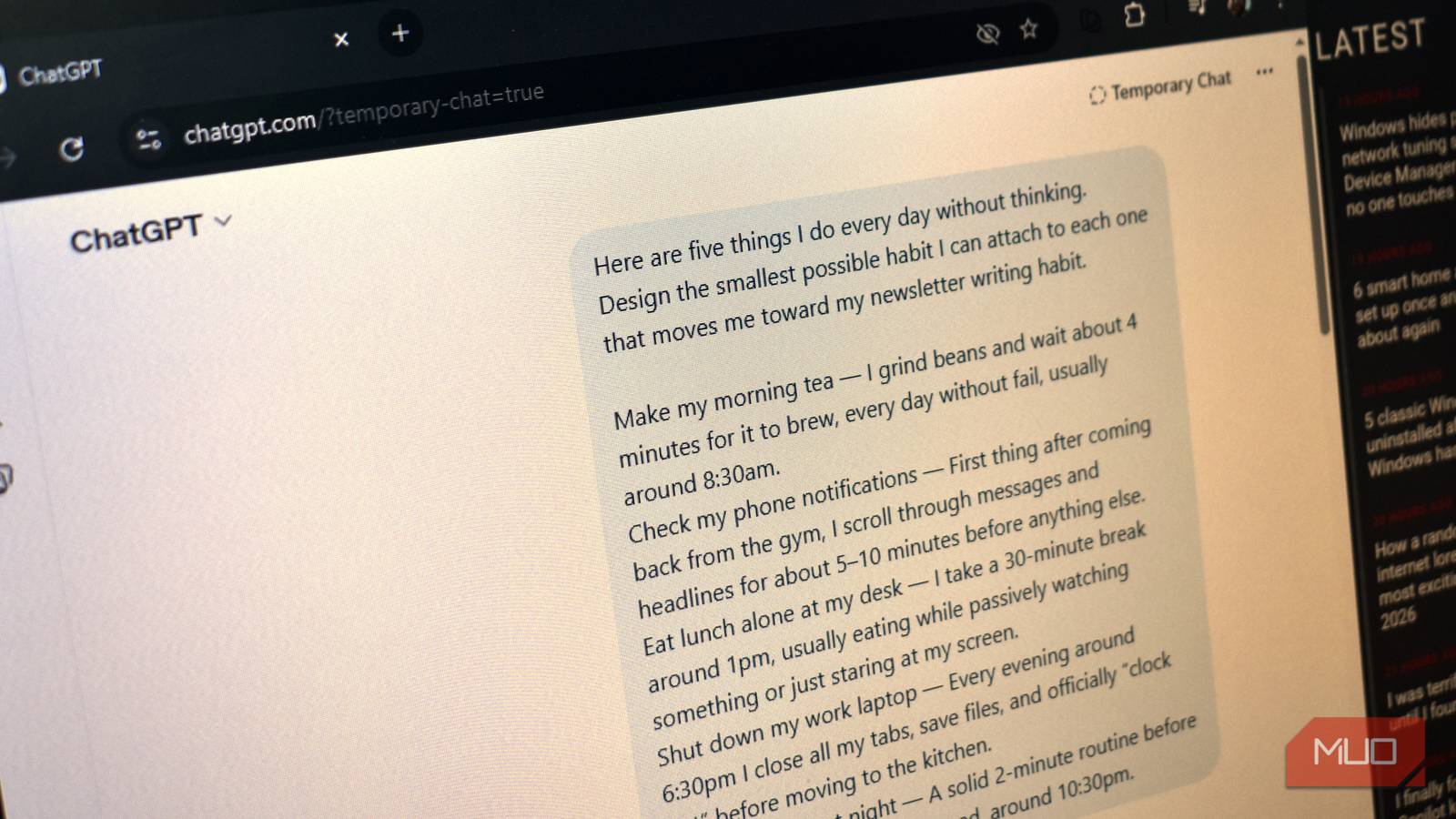
Attach new habits to what you already do. New behaviors stick when anchored to existing ones. Instead of carving out fresh time, which most of us don’t have, you attach a micro-habit to something you already do automatically. Ask ChatGPT:
Here are five things I do every day without thinking. Design the smallest possible habit I can attach to each one that moves me toward [goal].
My first instinct was that this sounded too small to matter. After all, how far would a two-minute habit take me? But these tiny minutes compound. Experimental psychologist BJ Fogg’s data shows that tiny habits done consistently beat ambitious habits done sporadically, every single time.
ChatGPT also helped me see that I was consistently overestimating what I’d do in a week and underestimating what I’d do in three months with the help of tiny habits.

8 small ChatGPT automations actually make my day faster
I used these simple scheduled prompt ideas to streamline my day
Stop relying on discipline
Save your willpower by redesigning your environment

Ego depletion research suggests that our willpower isn’t finite. It depletes like a battery. Using ChatGPT for setting morning routines is one way to stave off decision fatigue. Paste in your typical daily schedule and ask,
Where are the friction points that drain mental energy before I even reach my main goal?
I have had hits and misses with this. But it has surprisingly helped me think about unnecessary time sinks. It found low-stakes decisions every morning that were quietly draining my focus by 10 am. Eliminating them didn’t require discipline, but just a shift of priorities. ChatGPT helped me re-jig my time faster than I would have on my own and narrow down on my true goals for the day.
Feedback keeps you engaged
Make honest self-reporting part of the system
A system needs feedback to work. Without it, our brains lose interest. I use ChatGPT to review my work, score it, or suggest improvements. You don’t need a human coach to get this effect. Set up a recurring ChatGPT prompt where you report three things: what you planned, what you actually did, and one adjustment for tomorrow.
The act of writing it out creates a lot of clarity, and it’s not too different from putting it down on paper. ChatGPT can respond intelligently like an accountability partner. With the help of the AI prompts, the system becomes interactive rather than repetitive.
It can trigger a small but genuine sense of follow-through as ChatGPT’s follow-up questions push you to examine why something didn’t happen. Then, you use the answers to course correct your daily or weekly planning systems.
Use AI to act like your future self
Reinforce your belief in your goals

Instead of trying to “be productive,” I started acting like someone who shows up daily with the intention to take precise steps towards a goal. For instance, I ask ChatGPT to treat me like a writer, not someone trying to become one.
I ask ChatGPT to act like a mentor who already sees me as a writer. Each day, it gives me one small task, like writing 150 words or refining an idea, and I respond as if this is just what writers do.
Act as a mentor who assumes I am a consistent [role]. Give me one small task to complete today and review it accordingly.
This felt fake at first. Being treated like a writer when I procrastinate at the drop of a hat made me uncomfortable. But that discomfort amplified by ChatGPT’s feedback is the point. As cognitive science points out, when you repeatedly act like the person you want to become, your brain updates your identity to match your behavior. A system and time become your ally.
Restructure what’s already there and run with it
Start simple. Open ChatGPT and ask it to set up a system around one small task related to your goal. Maybe, pick one goal you’ve already failed at and ask ChatGPT to build an if-then implementation plan around your existing daily routine. Try this as a low-stakes experiment before you use the other systems for bigger goals.
