
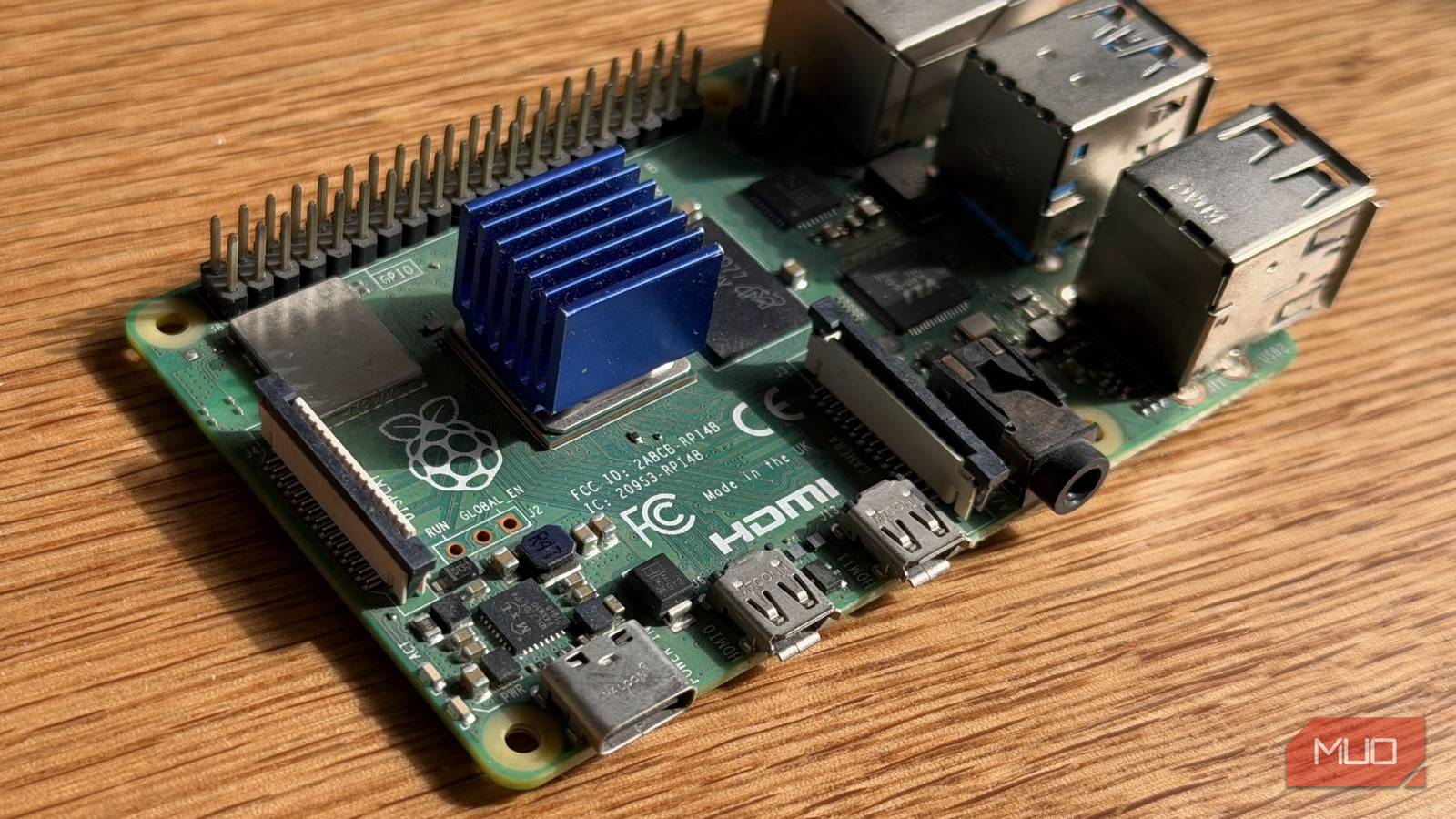
I have loved the Raspberry Pi for years. I still do. It made so many impossibles possible. I’ve used them for lots of projects. I had one that ran Kodi on Raspberry Pi OS. Now, I have a Raspberry Pi 4 running as an Android TV box. I have a third sitting idle that I keep meaning to do something with.
When I decided to move my Jellyfin server out of my computer and to a dedicated machine, a Raspberry Pi was what came to mind. It was instinct. But then, I checked the price.
The Pi 5 costs as much as a real computer now
Affordable Linux box? No.
The hard to swallow truth is that the Raspberry Pi is not an affordable mini-computer anymore. It’s a great mini-computer, but it’s not affordable.
A Raspberry Pi 5 with 8GB of RAM is $175. The 16GB model is $305. Those are board-only prices — before you’ve bought a case, a power supply, an NVMe HAT, or an SSD. By the time your Pi is actually ready to run as a server, you’ve easily crossed $250, possibly $300.
- Brand
-
Raspberry
- CPU
-
2.4GHz quad-core 64-bit Arm Cortex-A76 CPU
- Memory
-
16GB LPDDR4X
- Ports
-
4 USB ports, GbE, microSD, 2 mini-HDMI ports
The fifth iteration of the Raspberry Pi delivers significant CPU and graphics improvements over previous models, incorporating dual 4Kp60 HDMI output, faster USB 3.0 throughput, and a dedicated PCIe 2.0 interface for high-speed peripherals and advanced industrial or hobbyist applications.
For that money, you’re getting an ARM board with limited upgrade paths, no Thunderbolt — No, that’s the wrong angle. The Raspberry Pi 5, if you don’t look at the tag, is an amazing piece of hardware. However, when you do look at the price, there are just so many better options.
If you want something to play media with, you can get a used Xbox One S for $80 on eBay. No kidding. And this is an Xbox! Proper codecs, app support, and its hardware and software is designed to play media. Kodi, Jellyfin, and Plex are all available on the Xbox store.
But, if you want something more open and with more control (because good luck sideloading apps to an Xbox), then there are actual computers with better cost-effectiveness that are cheaper than a Pi. In fact, I got one of those.
I bought a used laptop instead
It cost less than a Pi 5 and I can’t stop talking about it
I paid $180 for a used Dell Latitude 5330. It has an Intel Core i5-1245U, 8GB of RAM, a 512GB SSD, and two Thunderbolt 4 ports. That last part still gets me. Two Thunderbolt 4 ports on a $180 machine means I can attach fast external storage, a dock, or a 10GbE adapter whenever I need to — without buying a new board or stacking HATs.

If you spot this port on a cheap used laptop, grab it before someone else does
I bought a cheap used laptop for server duty, then one port made the whole deal feel ridiculous.
More importantly for Jellyfin: the 1245U has Intel QuickSync. Hardware transcoding works properly, without me carefully curating my library to avoid formats the client can’t direct-play.
The laptop has a built-in UPS (I mean the battery), a screen for when I actually need one (I messed up the network the other day and couldn’t SSH), and a standard x86 architecture that runs every Docker image smoothly. And frankly, I don’t need to worry about whether the power supply is causing instabilities, and I don’t need to flash stuff on an SD card. I installed Ubuntu Server, set up Docker, and got on with it.
“But what about power consumption?”
This is the objection that always comes up. Yes, a Pi draws less power at peak. But this a laptop, with a 1245U built around efficiency cores. At idle, which is the majority of what a home server does, it’s not the power drain people imagine.
However, if the extra few watts of power draw is your primary concern, a Pi is still the right call.
The Pi still has its place
But it’s not the cheap board it used to be

The Raspberry Pi is still exactly the right tool for a certain class of jobs. If you’re building something into an enclosure, wiring up sensors over GPIO, mounting a board behind a display, or running a lightweight single-purpose service, it remains excellent. For those use cases, nothing has really changed.
What has changed is the price. And Raspberry Pi itself is not really the villain here. A big part of the problem is memory pricing. The AI infrastructure boom is eating into global memory manufacturing capacity, and small consumer hardware gets squeezed first.
A Raspberry Pi 5 8 GB and a Raspberry Pi 5 16 GB are identical in every spec except the RAM. The same processor, same ports, and same hardware. Right now, the Pi 5 8GB retails for $175. The Pi 5 16GB retails for $305! The only difference between the two, is the 8GB RAM that is seemingly worth $130. That gap tells the whole story. Memory is expensive, supply is tight, and manufacturers are prioritizing huge industrial contracts over low-margin enthusiast hardware. A hobbyist board like the Raspberry Pi ends up feeling that pressure more than most.
 |
None of us ever imagined a $300 price tag on a Raspberry Pi. |
The secondhand market changes the math to the Pi’s disadvantage. Corporate hardware leases create a reliable flood of capable machines hitting the used market every few years. ThinkPads, Latitudes, EliteBooks machines that were mid or high-end business hardware, maintained properly, and now available after three or four years of light office use. They’re built to last, they run cool and quiet, and they can be had for under $200 almost anywhere in the world.
The Pi earned its reputation when it was the cheapest accessible Linux box you could get your hands on. That was a fair fight. At $175 for the board alone, it’s not the same fight anymore.
Don’t let familiarity become a default
Don’t reach out for a Pi out of habit. It’s a tool that built a huge, passionate community, and that community association can make it feel like the obvious answer even when the problem doesn’t fit the tool.
Before your next build, do the actual price math. Check what’s on the used market in your area. You might find, like I did, that the smarter choice was sitting on eBay the whole time — and comes with Thunderbolt 4.
