
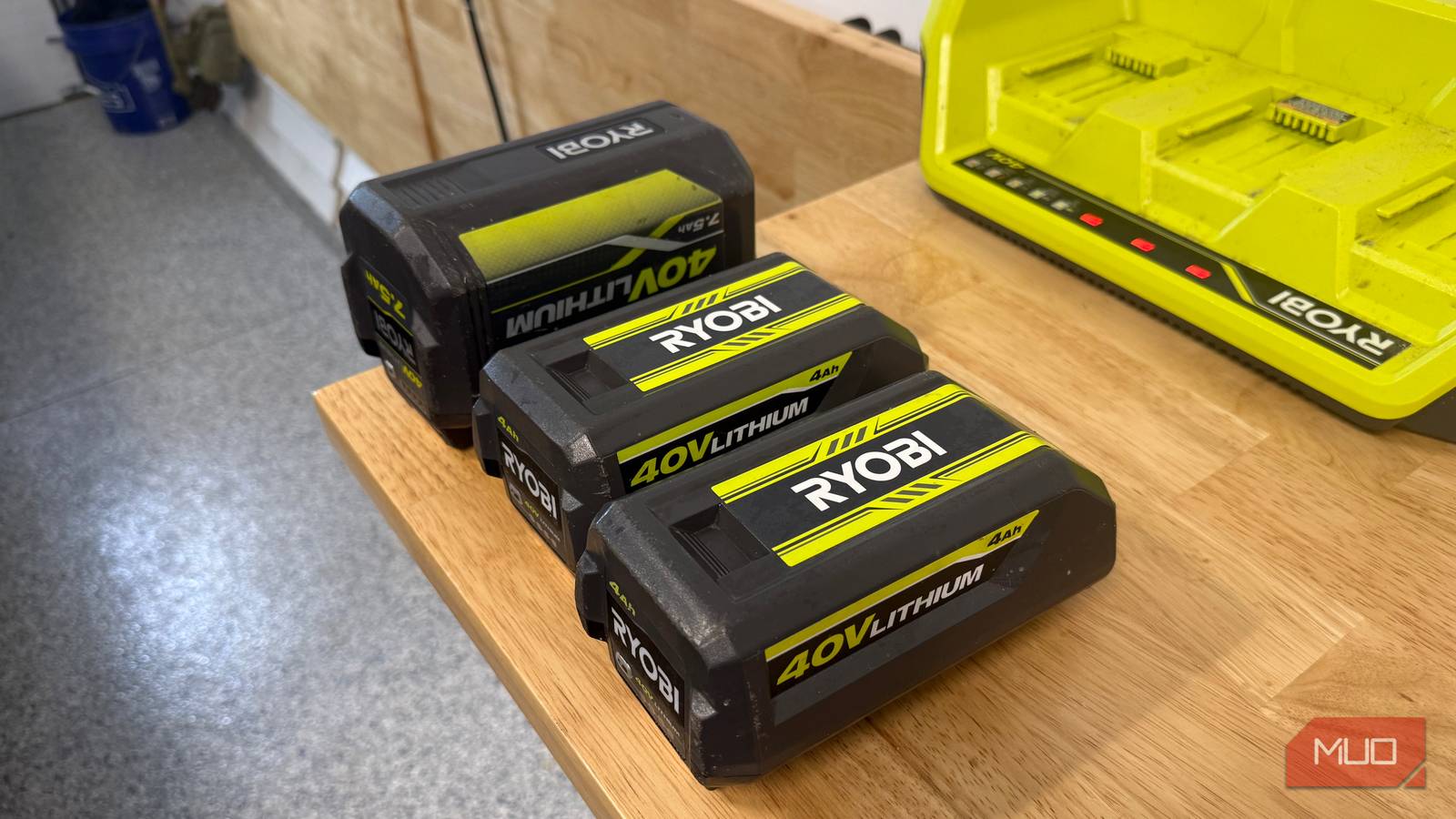
Ryobi ONE+ 4Ah battery packs regularly run $60 or more, and most serious tool users are cycling through several of them. If you’ve spent any time building out a cordless tool collection on the ONE+ platform, you know how quickly those costs compound. A drill kit here, a circular saw there, and suddenly you’ve got four or five packs rotating through your garage.
Most people assume heavy use is what shortens battery life. Run your tools hard enough, and the packs wear out. That’s the story. But after watching certain batteries in my own collection fade well before others — packs that hadn’t even seen that much use — I started digging into what was actually driving the degradation. The answer wasn’t just workload alone. It had more to do with what I was doing when the tools weren’t running.
The culprit sitting in your garage right now
A fully charged battery is under more stress than a working one
Here’s the habit most cordless tool owners never question: when a project wraps up, the batteries go back on the shelf at full charge. It makes sense on the surface. Full charge means ready to go. There’s no fumbling around waiting for a top-off when the next job starts.
The problem is that lithium-ion chemistry doesn’t sit comfortably at 100%. Cells held at full charge are under constant voltage stress, even when nothing is drawing current. Battery researchers have a term for it: calendar aging. It’s the slow erosion of capacity that builds up while a pack sits untouched — nothing to do with how many times it’s been charged and discharged.
The numbers bear it out: at full charge, a lithium-ion battery can shed up to 20% of its capacity in a single year just from sitting there. Keep that same pack in the 40–60% range, and that figure drops to under 5%. That’s not a rounding error. Run that gap across two or three years of seasonal storage, and you’re looking at noticeably reduced runtime on packs that should still have most of their life ahead of them.
Why the chemistry works against full storage
Voltage stress is what actually kills lithium-ion cells
Charge cycle count gets most of the attention in conversations about battery longevity, but cycles aren’t the whole story. What matters just as much — sometimes more — is how much time a battery spends near the voltage extremes. A high state of charge keeps cells in a stressed electrochemical state continuously. It’s the equivalent of holding a spring at full compression indefinitely versus cycling it through normal use. The spring fatigues faster under sustained load than it does from regular movement.
The 40–60% storage range isn’t a manufacturer preference — it’s the region where cell chemistry sits under the least strain. For tools you’re using regularly, this is a non-issue: the packs cycle often enough that storage charge barely registers. It’s the stretches of low activity where it bites. Late fall, when outdoor projects wind down. A busy stretch at work that keeps you out of the garage for six weeks. Any period where a pack might sit fully charged on a shelf for a month or more. That’s when the voltage stress compounds into something measurable.
The other end of the spectrum is just as damaging
A battery that goes dead and stays dead can become permanently dead
Storing at partial charge matters, but so does the other extreme. A fully depleted lithium-ion battery left alone long enough can slip into deep discharge — a state where the battery management system locks the pack out entirely as a protection measure. The charger sees nothing, or throws an error, and the pack is effectively dead regardless of what’s actually left in the cells.
This happened to me with a pack I’d left sitting in a drawer from fall through the following spring. When I finally dug it out and put it on the charger, nothing happened. The BMS had locked it out completely. The 40–60% target isn’t just about slowing calendar aging at the top end — it protects against this failure mode at the bottom end too. Both extremes damage lithium-ion cells. The middle is where they last.
Two more habits worth addressing in the same conversation
Cold charging and charger docks both quietly work against battery health

The storage charge problem is the headline, but two related habits belong in the same conversation. The first is cold charging. Cold storage doesn’t damage lithium-ion batteries — leaving packs in an unheated garage through January is fine. What causes permanent damage is plugging a cold battery straight into the charger. At temperatures below freezing, the charging process breaks down at the chemistry level. Lithium ions that should be absorbing into the anode end up depositing on its surface as metallic lithium — a form of degradation that’s structural and permanent. The fix costs nothing: bring the battery inside and let it reach room temperature before plugging it in. An hour is usually enough.
The second habit is using the charger as a storage dock. Modern chargers cut off current at 100%, so there’s no risk of acute overcharge. But many follow that cutoff with a low-level trickle charge to maintain full capacity as the cell naturally self-discharges. That trickle keeps the pack sitting at high voltage continuously — the same condition driving calendar aging.
After a session of driving fasteners — the kind of work where getting your drill’s clutch setting right saves you from stripping screws — pull the battery off the charger as soon as the indicator goes green. Over months and years, that five-second habit has a measurable effect on how long each pack stays in rotation.
A $70 battery lasts longer than it should when you handle it right
None of this requires a system or a spreadsheet. The practical version: when tools are going to sit for more than a few weeks, run any fully charged packs down before putting them away. If the indicator shows roughly half, that’s where you want it. Before charging anything that’s been in a cold garage, let it warm up indoors first. When the charger light turns green, unplug the pack. Three habits, none of them complicated, none of them costly. Replacing a degraded $70–$100 battery pack is a real expense. Every one of the practices that delays that replacement is free.
