

Stolen credentials accounted for 22% of known initial access vectors in 2025. It’s the most common way for attackers to breach a network, and once inside, excessive permissions and limited visibility often allow them to escalate unchecked.
Zero Trust is positioned as the answer. In theory, removing implicit trust and requiring every access request to be verified should improve security. But in practice, simply adopting Zero Trust principles isn’t enough.
If it’s implemented as a set of isolated controls rather than a cohesive identity strategy, gaps remain, and attackers will find them.
To truly strengthen identity security, Zero Trust must be applied with identity at its core: tightly governed, continuously validated, and fully visible across the environment. The following five approaches show how a well-executed Zero Trust model strengthens identity security in practical, measurable ways.
1. Enforcing least privilege access
It’s common for users to accumulate permissions over time as roles change, projects evolve, or temporary access isn’t revoked. The result is a level of access that far exceeds what users actually need for their job.
If attackers compromise that account, they inherit those same privileges, giving them a broader foothold from the outset.
Zero Trust applies the principle of least privilege to limit that exposure. Access is contingent upon specific requirements, rather than broad or permanent permissions. That means just-in-time access and time-bound privileges, with strict segmentation between systems and data.
If credentials are stolen, the potential impact is then contained. Attackers are far less able to escalate privileges or access sensitive systems, reducing both the likelihood and severity of a breach.
Verizon’s Data Breach Investigation Report found stolen credentials are involved in 44.7% of breaches.
Effortlessly secure Active Directory with compliant password policies, blocking 4+ billion compromised passwords, boosting security, and slashing support hassles!
2. Continuous, context-aware authentication
In a Zero Trust environment, treating authentication as a one-time event at login is a dangerous oversight. Attackers now use session hijacking and token theft to bypass initial checks entirely, moving through the network under the guise of a legitimate user.
They often leverage compromised devices to blend in with normal activity, remaining invisible to traditional security triggers.
Organizations need continuous, context-aware authentication to address this gap. Instead of relying solely on credentials, device health should also influence access decisions.
Solutions like Specops Device Trust deliver that assurance. By binding identities to trusted devices, it prevents attackers from using passwords on their own hardware or unknown virtual environments.
If a device falls out of compliance, such as through a disabled firewall or missed update, users are prompted to fix it, and access can be restricted or revoked until they do.
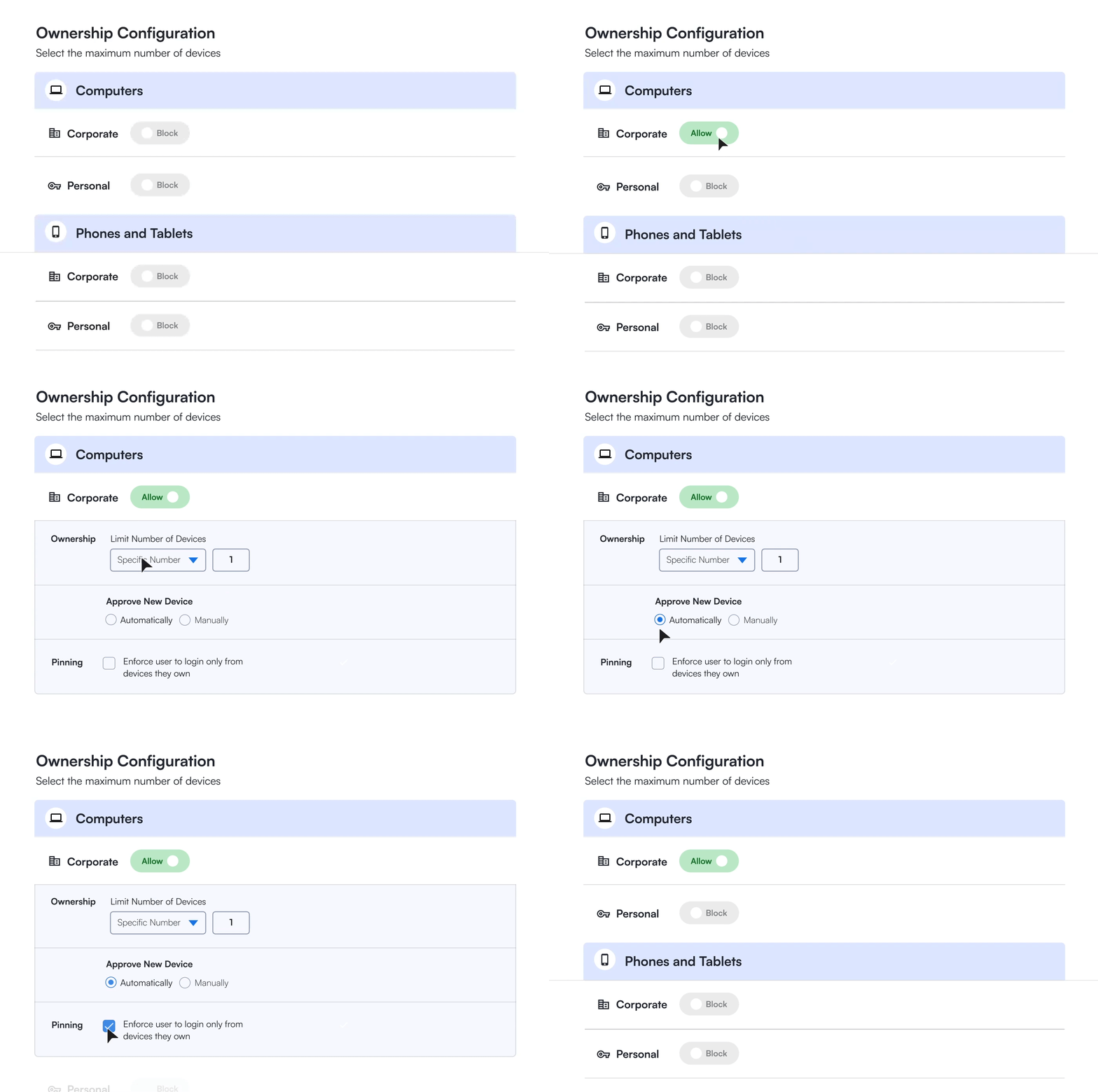
Additionally, Specops Device Trust supports Windows, macOS, Linux, iOS, and Android, enabling consistent device trust across an organization’s entire network, including BYOD and third-party devices.
This adds a crucial layer to identity security as credentials are far harder to abuse without a trusted device.
3. Limiting lateral movement
Zero Trust is designed to disrupt an attacker’s progression from initial compromise to privileged access. This involves segmenting access at a granular level and continuously verifying identity for each new request, rather than allowing unrestricted movement within the network.
Even users with legitimate access are limited to only the systems and data required for their role. This means that should an account be breached, the attacker’s ability to explore the environment, escalate privileges, or reach high-value assets is constrained at every step.
In practice, this containment can be the difference between a minor incident and a large-scale breach, turning what could have been widespread compromise into a far more manageable security event.
4. Securing remote work and third-party access
Remote work and third-party collaboration have become standard, but they also introduce additional identity risk. Employees are logging in from unmanaged devices and networks, alongside vendors and partners.
In traditional models, this access is frequently overprovisioned or insufficiently monitored, creating gaps that attackers can exploit. A compromised third-party developer account, for example, offers a direct route into sensitive environments.
Zero Trust addresses this by treating every user and device as untrusted by default. Access is granted based on verified identity, device posture, and context, rather than network location or assumed trust.
This allows organizations to apply consistent security controls across all access points. Third-party users can be restricted to specific systems; sessions can be monitored more closely, and access can be revoked as soon as it’s no longer needed.
5. Centralized identity governance and monitoring
As identity environments grow, so does the challenge of maintaining visibility and control. Particularly in larger organizations, users, roles, applications, and permissions are spread across multiple systems, making it difficult for security teams to see who has access to what at any given time.
Zero Trust brings identity governance and monitoring into a more centralized model. Security teams can manage access policies, authentication events, and user activity from a single point, rather than in isolation.
Unusual access patterns, privilege changes, or policy violations can be detected and investigated more quickly, reducing the time attackers have to operate undetected.
Implementing Zero Trust identity security in your organization
Moving toward a Zero Trust model is a journey, not a weekend project. You don’t have to overhaul everything at once. Most organizations find the most immediate success by prioritizing phishing-resistant multi-factor authentication and device health checks first.
By starting with these high-impact controls, you can secure your most vulnerable entry points while gradually tightening least-privilege policies across the rest of your infrastructure.
Interested in seeing how Specops’ identity security services can help your organization move towards true Zero Trust authentication?
Contact us today or book a demo to see our solutions in action.
Sponsored and written by Specops Software.
